Hiring Your Child in Your Family Business (2026): Payroll Tax Rules, Savings Math and Paperwork
↓ Get the free Excel + PDF kit for this article
Your 15-year-old already scans receipts, restocks shelves and takes product photos for your shop. Should you be paying them, and if you do, what happens with payroll taxes? For many family businesses, putting a child on payroll is one of the simplest legitimate year-end moves: the wages are a business expense for you, and the child can earn up to the standard deduction without owing federal income tax.
But the rules depend on two things people often get wrong: who owns the business and how old the child is on payday. Get either one wrong and you either miss the benefit or under-withhold payroll taxes. This guide walks you through the rules, the math, and the paperwork, with formulas you can type into Excel or Google Sheets.
Who this is for: owners of a sole proprietorship, a one-owner LLC, a partnership with a spouse, or an S or C corporation who want to pay a child for real work before December 31, 2026.
Step 1: Find out which payroll taxes apply
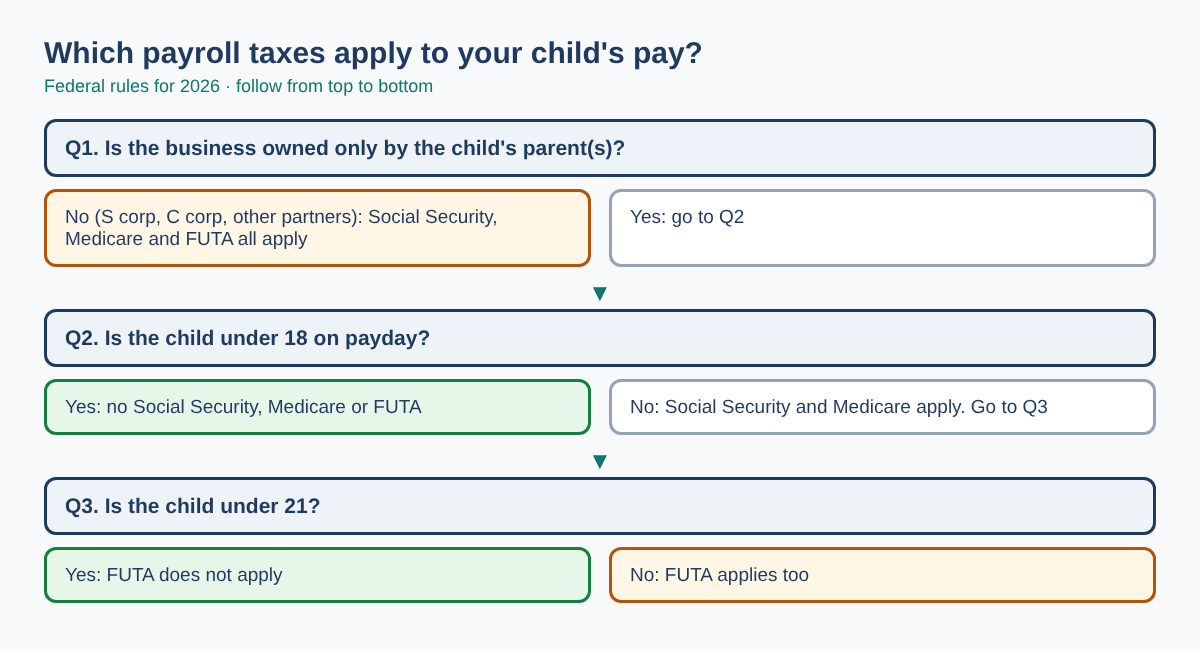
Under IRS rules, a child under 18 who works for a parent's sole proprietorship (or for a partnership where every partner is a parent of the child) is not subject to Social Security and Medicare taxes, and a child under 21 is not subject to FUTA. If the business is a corporation, or a partnership with any non-parent partner, those taxes apply at any age.
| Who owns the business | Child under 18 | Child 18-20 | Child 21+ |
|---|---|---|---|
| Parent as sole proprietor (incl. a 1-owner LLC not taxed as a corporation) | No Social Security/Medicare, no FUTA | Social Security/Medicare apply, no FUTA | All apply |
| Partnership where every partner is a parent of the child | No Social Security/Medicare, no FUTA | Social Security/Medicare apply, no FUTA | All apply |
| S corporation, C corporation, or partnership with a non-parent partner | All apply | All apply | All apply |
Federal income tax withholding rules apply at every age. Source: IRS, Family Employees.
Two details that trip people up
- A one-owner LLC that has not elected corporate tax treatment is treated like a sole proprietorship for this rule. An LLC taxed as an S corporation is an S corporation: no family exemption.
- Age is checked on each payday. If your child turns 18 in August, pay after the birthday is subject to Social Security and Medicare.
Step 2: Estimate the savings with a few formulas
Put the wages in cell B1 and your federal bracket in B2 (for example 22%). For a parent-owned business with a child under 18:
- Income tax you save:
=B1*B2 - Self-employment tax you save:
=B1*0.9235*0.153(use 0.029 instead of 0.153 if your self-employment earnings are already above $184,500) - Child's standard deduction (2026, dependent with wages only):
=MIN(16100, MAX(1350, B1+450)) - Child's taxable income:
=MAX(0, B1 - B3)where B3 holds the result of step 3 - Family savings: steps 1 + 2, minus any payroll taxes and the child's tax
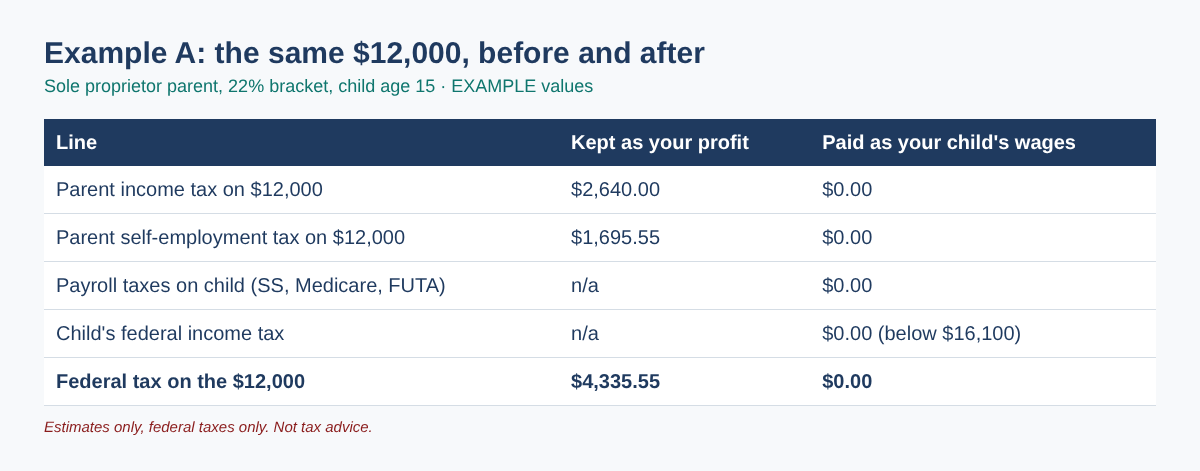
With $12,000 of wages and a 22% bracket, that is $2,640 + $1,695.55 = $4,335.55, and the child owes no federal income tax because $12,000 is below the $16,100 standard deduction. Example values only.
Three example families
The benefit shrinks when payroll taxes apply. Here is the same idea for three different families:
| EXAMPLE values | A: Sole prop, age 15 | B: S corp, age 16 | C: Parents' partnership, age 19 |
|---|---|---|---|
| Wages | $12,000 | $12,000 | $16,100 |
| Parent's bracket | 22% | 24% | 22% |
| Social Security + Medicare (business + child) | $0 | $1,836.00 | $2,463.30 |
| FUTA | $0 | $42.00 | $0 |
| Income tax saved by the deduction | $2,640.00 | $3,110.40 | $3,812.96 |
| Self-employment tax saved | $1,695.55 | n/a | $464.17 |
| Child's federal income tax | $0 | $0 | $0 |
| Estimated family savings | $4,335.55 | $1,232.40 | $1,813.83 |
Examples only. Federal taxes only. C: the parent's self-employment earnings are above the $184,500 Social Security wage base, so only the 2.9% Medicare part is saved.
For a corporation, the payroll taxes are real costs. For a C corporation the deduction is valued at the 21% corporate rate, so check the math before you start.
Step 3: Set it up like a real job
- Write a short job description with age-appropriate business tasks: filing, scanning, cleaning the shop, stocking, social media photos, data entry.
- Set a fair rate: what you would pay an unrelated person for the same work. Pay far above market may not be deductible.
- Paperwork on day one: Form W-4 and Form I-9, like any other employee, and a state new-hire report if your state requires it.
- Keep a timesheet: date, task, start and end time. A simple spreadsheet works:
=(End-Start)*24gives hours. - Pay from the business account by check or direct deposit to an account in the child's name. Avoid cash.
- Run it through payroll: include the wages on Form 941 (or 944). If the family rule applies, do not withhold Social Security or Medicare.
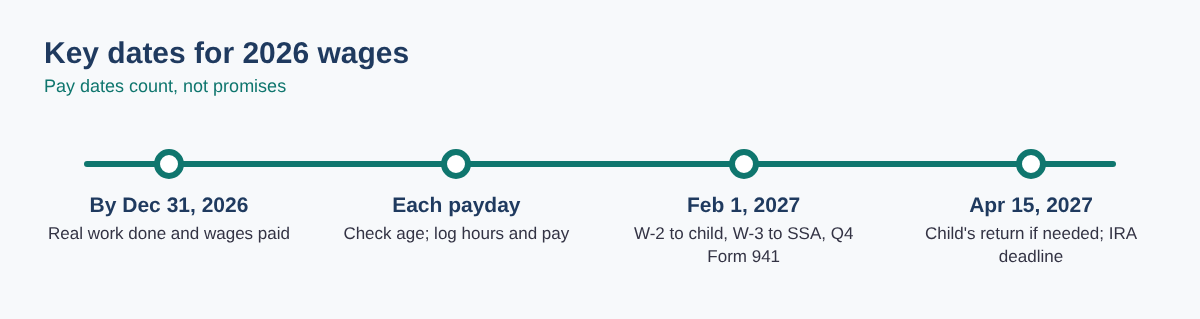
- Year end: give the child a Form W-2 and file Form W-3. For 2026 wages the due date is February 1, 2027, because January 31 falls on a Sunday.
Common mistakes
- Claiming the family exemption for an S corporation or an LLC taxed as one.
- Paying a full year of "wages" in one December check with no record of the work.
- Paying cash, or paying for household chores rather than business work.
- Skipping the Form W-2 because no tax was withheld.
- Forgetting state rules: child labor hours and permits, state unemployment insurance and state income tax.
- Paying a grandchild, niece or nephew and assuming the parent-child exemption applies. It does not.
FAQ
Does my child have to file a tax return?
Often not, if wages are the only income and stay at or below the standard deduction. A child may still want to file to get back any federal income tax that was withheld. Check the IRS filing requirements for dependents each year.
Can my child open a Roth IRA with these wages?
Wages are earned income, so the child can contribute up to the lesser of the wages or the 2026 IRA limit of $7,500. A custodial account is usually needed for a minor.
What if my child turns 18 during the year?
Pay before the birthday keeps the exemption; pay after it is subject to Social Security and Medicare (FUTA stays exempt until 21 for a parent-owned business). Track the age on each pay date.
How young can my child be?
The tax rules have no minimum age, but the work must be real and age-appropriate, and federal and state child labor rules still apply. Federal law has a parental exemption for many non-hazardous jobs; your state may be stricter.
Does this work for my S corporation?
You can still pay your child, and the wages are deductible, but Social Security, Medicare and FUTA apply at any age, which reduces the savings.
Quick checklist
- Business type confirmed (family rule only for parent-owned businesses)
- Job description and fair hourly rate written down
- W-4, I-9 and state new-hire report done
- Timesheet kept for every shift
- Paid from the business account, not in cash
- Wages included on Form 941 / 944
- W-2 and W-3 filed by February 1, 2027
- State child labor, unemployment and tax rules checked
Want a ready-made workbook?
You can download the ready-made Hiring Your Child: 2026 Family Payroll Planner (formulas, timesheet, pay log that checks the 18th birthday, and year-end checklist) for free in the Free kit download box below (Excel + PDF guide, no sign-up).
This article is for education only and is not tax, legal or financial advice. Figures are federal and for 2026; state rules vary. Confirm your situation with a qualified tax professional.
Sources: IRS, Family Employees: https://www.irs.gov/businesses/small-businesses-self-employed/family-employees · IRS Publication 15 (2026), Employer's Tax Guide (Social Security wage base $184,500; FUTA 6.0% on the first $7,000, credit up to 5.4%): https://www.irs.gov/publications/p15 · IRS, Inflation-adjusted tax items by tax year (2026 standard deduction and brackets, Rev. Proc. 2025-32): https://www.irs.gov/newsroom/inflation-adjusted-tax-items-by-tax-year · IRS IR-2025-111 (2026 IRA limit $7,500): https://www.irs.gov/newsroom/401k-limit-increases-to-24500-for-2026-ira-limit-increases-to-7500 · IRS Publication 926 (2026) for the February 1, 2027 W-2 date: https://www.irs.gov/publications/p926 · US Department of Labor, child labor: https://www.dol.gov/agencies/whd/child-labor
Free kit download
Tools to follow this article step by step. No sign-up needed.
- Excel workbook (.xlsx)Hiring_Your_Child_Payroll_Planner_2026_EN.xlsx · 38 KB
- Step-by-step guide (PDF)Hiring_Your_Child_Guide_2026_EN.pdf · 157 KB
Free to use for yourself and your own business; please do not resell or redistribute. General information, not tax, legal or accounting advice; check every figure against your own records.